
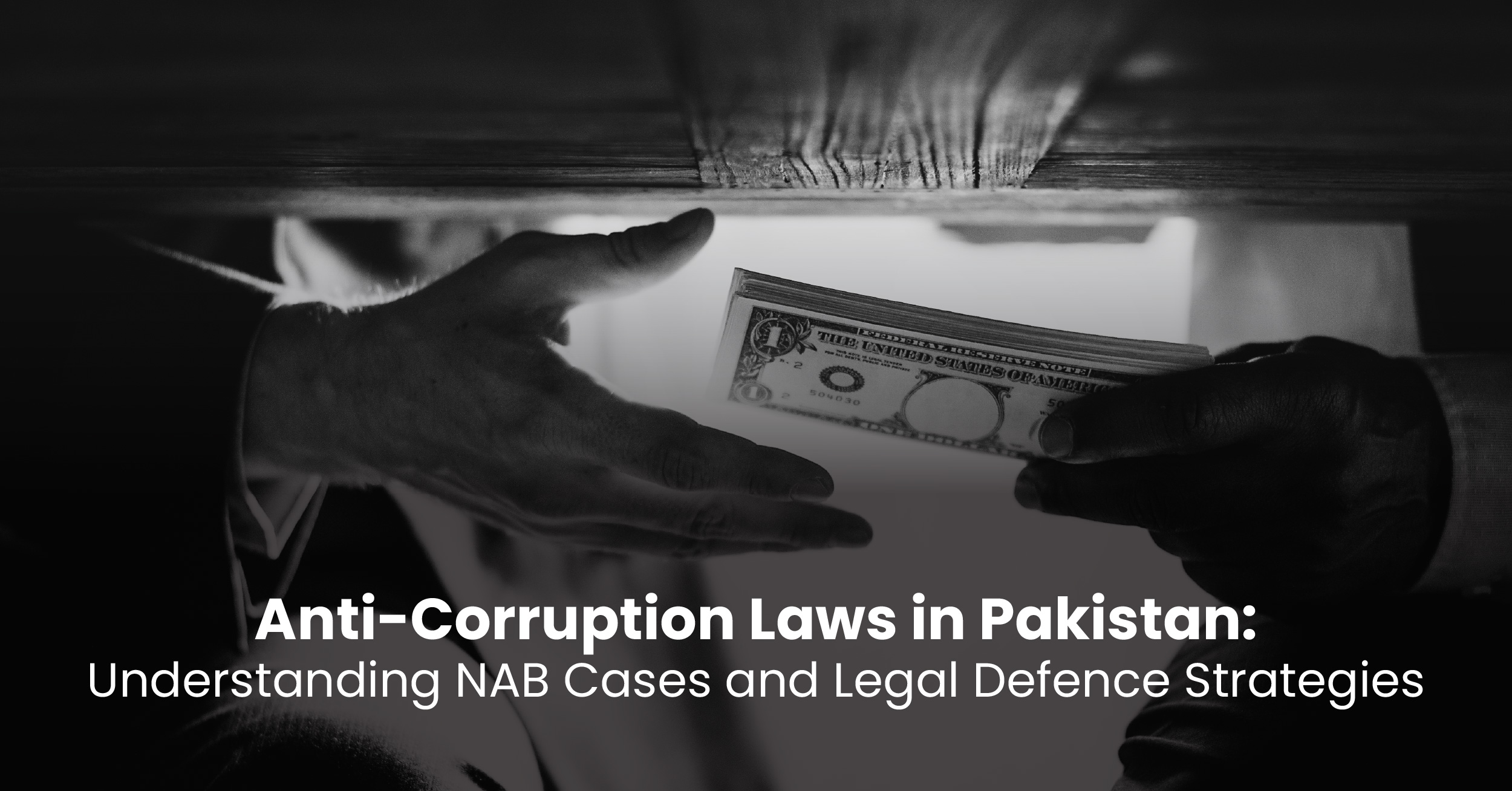
Corruption has long been one of the biggest challenges to governance and economic stability in Pakistan. To address this issue, the country has developed a legal framework designed to ensure accountability and transparency.
This system is executed by the institution of National Accountability Bureau (NAB), which investigates and prosecutes corruption cases.
Understanding how anti-corruption laws work is important not just for public officials but also for private individuals and businesses. Many people are unsure about how NAB cases proceed or what legal options are available if they are accused.
Therefore, to know how anti-corruptions laws in Pakistan work read more.
What is Meant By Anti-Corruption Laws in Pakistan?
Pakistan’s anti-corruption framework is primarily governed by the National Accountability Ordinance 1999 (NAO). This law provides NAB with the authority to investigate corruption, misuse of power, and financial irregularities.
It applies to both public office holders and private individuals involved in corrupt practices. Under this legal system, corruption is not limited to bribery. It includes actions such as accumulating assets beyond known sources of income, abusing authority for personal gain, and causing financial loss to the state.
Other laws, including certain provisions of the Pakistan Penal Code, also support the accountability process.
How NAB Cases Work in Pakistan?
A case begins with a complaint, which may come from individuals, institutions, or government bodies. The process generally follows these steps:
- Inquiry Stage: NAB conducts an initial review to assess whether the complaint has merit
- Investigation Stage: If sufficient evidence is found, a full investigation begins
- Arrest and Remand: NAB may arrest the accused and seek physical remand for further questioning
- Reference Filing: A formal reference is filed in an accountability court
- Trial Proceedings: The court examines evidence, hears arguments, and delivers a verdict
Accountability courts are responsible for ensuring that cases are decided based on evidence and legal principles. While the law emphasizes speedy trials, delays can still occur due to complex financial investigations and legal challenges.
What Are Common Types of NAB Cases?
NAB handles a wide range of corruption-related offences. Some of the most common types include:
- Corruption and corrupt practices involving bribery or illegal financial benefits
- Assets beyond means when an individual cannot justify their wealth through legal income
- Abuse of authority regarding misuse of official position for personal gain
- Financial fraud and embezzlement regarding misappropriation of public or private funds
In many cases, these charges are interconnected. For example, abuse of authority may lead to financial gain, which then results in assets beyond known income sources.
What Does Legal Defence in NAB Cases Pakistan Mean?
Facing accountability proceedings can be overwhelming, which is why hiring a skilled criminal defence lawyer in Pakistan is often an important step. Legal defence in NAB cases focuses on protecting the accused’s rights while challenging the prosecution’s claims.
One of the most important protections is the right to a fair trial. The defence team examines whether NAB followed proper legal procedures during the investigation and arrest. Any violation of due process can weaken the prosecution’s case.
Bail is another key aspect of legal defence. Although bail in NAB cases is more difficult to obtain compared to regular criminal cases, courts may grant it if there is insufficient evidence or procedural irregularities.
The List of Legal Defence Strategies in Accountability Cases
A good defence strategy depends on the specifics of each case. However, some defense common approaches include:
- Challenging evidence where questioning the authenticity and reliability of documents and financial records is executed.
- Proving legitimate income involving demonstrating lawful sources of assets through financial documentation
- Highlighting procedural flaws which helps in identifying errors in investigation or arrest procedures
- Lack of intent, showing that there was no deliberate intention to commit corruption
- Using judicial precedents to rely on previous court decisions to strengthen the defence
Each of these strategies requires careful preparation and a clear understanding of both legal and financial aspects of the case.
What Is Role of Higher Judiciary in NAB Cases?
The higher judiciary plays a significant role in maintaining balance within the accountability system. Courts review NAB’s actions to ensure they do not violate constitutional rights such as due process and fair trial.
The Supreme Court of Pakistan has issued several landmark judgments that have clarified the limits of NAB’s authority. These decisions have influenced how investigations are conducted and how evidence is evaluated in accountability courts.
Judicial oversight is essential in maintaining public trust in the system, especially in cases involving high-profile individuals.
What Are The Challenges in the Accountability System?
Despite its importance, Pakistan’s accountability system faces several challenges including:
- Delays in trials where complex cases often take years to resolve
- Selective accountability concerns showing allegations that laws are applied unevenly
- Legal ambiguities to ensure certain provisions of the law remain open to interpretation
- Impact on business meaning fear of investigations can discourage investment
Addressing these challenges is necessary to ensure that anti-corruption efforts are both effective and fair.
Reforms and the Future of Anti-Corruption Laws
In recent years, there have been several efforts to reform accountability laws in Pakistan. These reforms aim to improve transparency, reduce misuse of authority, and align the system with constitutional principles.
Proposed changes often focus on limiting arrest powers, strengthening judicial oversight, and ensuring faster trial processes. The goal is to create a system that holds individuals accountable without compromising their fundamental rights
As the Pakistani anti-corruption state continues to change, the effectiveness of its anti-corruption framework will depend on how well it balances enforcement with fairness.
Deal Your NAB Cases With Ahmad Law’s Legal Guidance
Understanding anti-corruption laws is not just important for legal professionals as it’s essential. It is important for anyone who wants to stay informed about their rights and responsibilities. If you are involved in or concerned about a NAB case, get in touch with us.
At Ahmad Law, we will offer you timely legal advice that can make a significant difference. Our expert lawyers can help you stay aware, stay informed, and always help you with expert consultation to deal with complex accountability proceedings. We know how to deal with legal cases no matter how complex, so do not delay and contact us.
FAQs
What is the role of NAB in Pakistan?
NAB investigates and prosecutes corruption cases, focusing on financial crimes, abuse of authority, and unlawful assets.
Can a person get bail in a NAB case?
Yes, but bail is granted cautiously and depends on evidence, procedural compliance, and the nature of allegations.
What is a plea bargain in NAB cases?
It allows an accused person to return illegal gains in exchange for reduced penalties, subject to court approval.
Who can be investigated under NAB laws?
Both public officials and private individuals can be investigated if they are involved in corrupt practices.
