
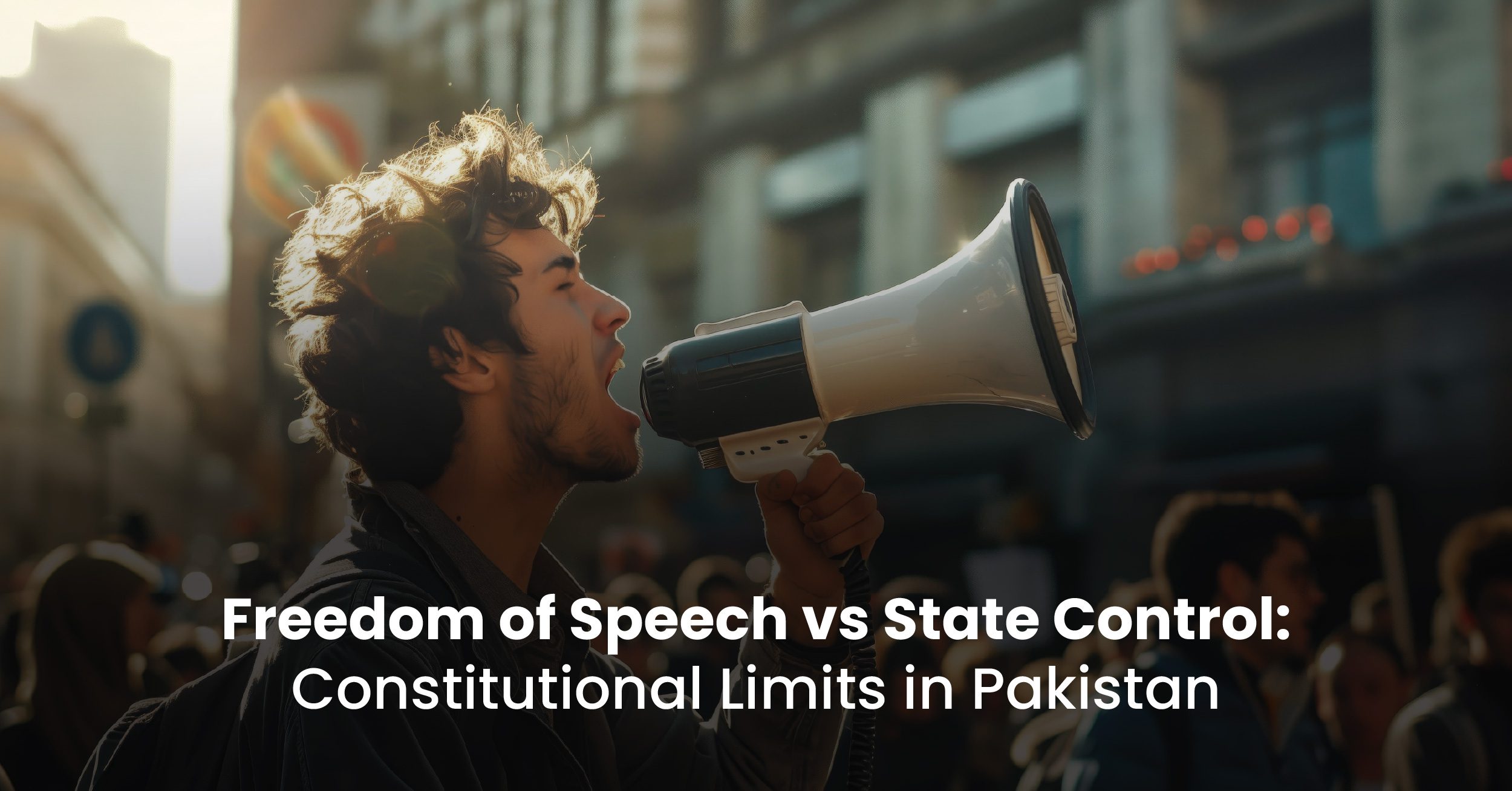
Freedom of speech is a cornerstone of democratic governance and civic participation. In Pakistan, this right is codified in the Constitution but is also subject to specific restrictions that reflect the country’s legal, social, and political context.
However, balancing individual liberties with collective stability and public order has been a persistent constitutional and judicial challenge. Today, at Ahmad Law we are exploring how Pakistan’s legal framework defines freedom of speech, the scope of state control, and where constitutional limits have been drawn in judicial rulings.
Constitutional Foundation: Article 19 of the Constitution of Pakistan
The Constitution of the Islamic Republic of Pakistan guarantees freedom of speech and expression as a fundamental right. Article 19 states:
“Every citizen shall have the right to freedom of speech and expression, and there shall be freedom of the press, subject to any reasonable restrictions imposed by law in the interest of the glory of Islam or the integrity, security or defence of Pakistan … public order, decency or morality, or in relation to contempt of court, commission of or incitement to an offence.” (infopakistan.pk)
This formulation reflects a dual nature: entitlement to free expression and a built-in mechanism for limitation (“reasonable restrictions”). The specification of interests such as public order and security highlights the idea of permissible restrictions.
Meaning of “Reasonable Restrictions”
The Constitution of Pakistan does not provide a clear definition of the phrase “reasonable restrictions” under Article 19. Instead, it explicitly lists the grounds on which the State may lawfully limit freedom of speech, including the glory of Islam, integrity and security of Pakistan, defence, friendly relations with foreign states, public order, decency or morality, contempt of court, and incitement to an offence.
Because the term “reasonable” is not defined in the constitutional text, its interpretation has largely been shaped by Pakistani courts. The judiciary has consistently held that any restriction imposed on speech must have a clear legal basis, must fall within one of the constitutionally enumerated grounds, and must not be excessive in relation to the objective sought to be achieved.
Emphasis of Pakistani Courts on “Restrictions”
Pakistani courts have further emphasized that restrictions cannot be arbitrary, vague, or disproportionately broad. Laws curtailing speech are subject to judicial scrutiny to ensure they are narrowly applied and directly connected to protecting legitimate state interests.
In several rulings, the superior courts have highlighted and endorsed that while freedom of expression is not absolute, limitations must be justified through necessity and legal clarity rather than administrative discretion.
Thus, in Pakistan’s constitutional framework, “reasonable restrictions” function as a balancing mechanism, allowing the State to protect national and societal interests while preventing misuse of regulatory powers to suppress lawful dissent or criticism.
Judicial Interpretation: Balancing Rights and Control
Supreme Court on Contempt and Speech
In one landmark case, the Supreme Court of Pakistan held that the right to freedom of speech “is not absolute, unlimited or unfettered” and cannot be extended to include speech that scandalizes the court or hampers the administration of justice. Specifically, the court noted that comments intended to bring the judiciary “into hatred, ridicule or contempt” fall outside constitutional protection. (The Express Tribune)
This shows how judicial oversight can restrict speech when it directly interferes with another constitutional value, as in this case, the integrity of the judicial system.
Islamabad High Court (IHC) on Free Speech and Contempt
In another ruling, the Islamabad High Court highlighted the importance of restraint, stating that judicial contempt laws should be applied in ways that respect the right to free speech guaranteed under Article 19. The court stressed that restrictions on critique of judicial decisions must be “least restrictive” to avoid undermining constitutional freedoms. (pakistanpressfoundation.org)
This line shows how courts may lean toward protection of expression, especially when enforcement mechanisms risk overreach.
Judicial Review of Charges and Freedom of Expression
In an April 2023 case, the IHC dismissed a charge of “baghawat” (insurrection) against a political figure for lack of lawful process, reaffirming that legal actions that curtail speech or political expression must follow constitutional procedures rather than be misused as punitive tools. (sabahnews.net)
State Control Mechanisms in Practice
Media Regulation
Regulatory bodies like the Pakistan Electronic Media Regulatory Authority (PEMRA) oversee broadcast media licensing and content standards, often invoking statutory provisions tied to public order and decency. While regulatory oversight aims to prevent harmful content, critics argue that enforcement sometimes leads to suppression of political voices.
Digital Speech and Cyber Laws
The Prevention of Electronic Crimes Act (PECA) 2016 is one of the most significant laws affecting online speech. It criminalizes certain online activities, such as promoting hate speech or publishing defamatory content, and has become the subject of constitutional petitions challenging its compatibility with Article 19.
Recently, a petition was filed in the Sindh High Court arguing that PECA’s requirements, such as compelling journalists to disclose sources, violate fundamental rights including freedom of expression. (AAJ News)
Judicial Suspension of Restrictive Orders
In 2025, a Pakistani court suspended a magistrate’s order to ban YouTube channels of critics , including opposition figures, for allegedly sharing provocative content, citing lack of legal basis and procedural fairness. (Reuters)
This example shows how courts can act as a check on executive or administrative actions that may over-reach constitutional limits.
Rights That Are Not Absolute
Recent jurisprudence confirms that certain forms of expression are not constitutionally protected. In a 2024 order, the Supreme Court held that freedom of expression does not extend to abusive or insulting speech that violates others’ rights or reputations, aligning Pakistan’s constitutional standards with international norms. (The Express Tribune)
Such rulings clarify that while citizens enjoy free speech, this right is not a license for harassment, incitement, or defamatory conduct. And if citizens are suffering from getting their due rights exercised then , a professional law firm in Pakistan can help individuals by representing them before high courts or the Supreme Court, assist with drafting petitions, and advise on compliance with constitutional protections.
Comparative Context: Limits Elsewhere
In constitutional democracies like the United States, the First Amendment offers robust protections with narrow exceptions (e.g., imminent lawless action).
But Pakistan’s Article 19 explicitly lists categories such as security and decency, giving legislatures and courts structured grounds for restricting speech. Comparative jurisprudence often shows Pakistani debates around review standards and proportionality in restrictions.
Digital Age Challenges
The rise of social media has complicated the speech regulation. Besides state laws, platforms enforce their own content policies, which sometimes clash with constitutional protections. Additionally, technological surveillance, including internet firewalls and mobile monitoring has raised concerns among human rights groups about chilling effects on dissent. (Reuters)
These developments highlight the need for legal understanding and potential reforms in light of changing digital norms.
Why Constitutional Limits Matter?
Understanding constitutional boundaries is important for journalists, activists, legal practitioners, and content creators. As the legal framework evolves, individuals facing allegations under speech-related laws, whether under media regulations, cyber laws, or public order statutes, may require professional counsel.
In such a scenario, seeking legal advice in Pakistan is essential when rights are allegedly violated, charges are framed under restrictive laws, or when navigating petitions challenging legal provisions.
Know Your Rights With Ahmad Law
Freedom of speech in Pakistan is constitutionally guaranteed yet carefully circumscribed by legal and judicial mechanisms designed to protect broader social and state interests. Judicial interpretations reflect an ongoing effort to balance individual liberties with public order, security, and institutional integrity. As digital platforms expand the reach of expressive activity, these constitutional debates will continue to shape how citizens exercise their rights.
That is why we at Ahmad Law have got you covered. Whether defending rights in court or challenging overly broad laws, our legal expertise can help you deal with the complex constitutional terrain in Pakistan.
FAQs
Is freedom of speech absolute in Pakistan?
No. Article 19 of the Constitution guarantees freedom of speech but allows reasonable restrictions in the interest of security, public order, morality, and other specified grounds.
Can social media content be restricted under Pakistani law?
Yes. Online speech may be regulated under laws like the Prevention of Electronic Crimes Act (PECA), particularly where content involves hate speech, defamation, or threats to national security.
When should someone seek legal help regarding free speech issues?
If you face charges, censorship, or legal notices related to speech or online expression, it is advisable to seek professional legal advice to understand your constitutional rights and available remedies. Get in touch with us for professional legal guidance and support.
